Why water comes first in Central Florida
Orlando averages roughly 50 inches of rain a year, and most of it falls from June through September, often in short, heavy afternoon storms. A paved surface changes where that water goes. Plan it well and water sheds away from the house into lawn, beds, or drains. Plan it poorly and water ponds against the foundation, washes out bedding sand, or lands on a neighbor's lot.
1. Watch where the water goes now
The best drainage information comes from your own yard during a real storm.
- Where do downspouts discharge, and where does that water travel?
- Where does water stand for more than a few hours after rain?
- Does water arrive from a neighbor's yard, the street, or a slope above you?
- Are there swales — shallow, grassy channels — that carry water along property lines?
Take photos or short videos during and after a heavy rain. They're more useful than any description.
- 1. Roof water: gutters and downspouts shouldn’t dump onto the patio or soak its base. Piping to an outlet in the lawn is one common option.
- 2. The patio surface slopes away from the house.
- 3. The base should drain rather than hold water; wet or low sites need extra planning.
- 4. A shallow swale carries water along the yard toward an appropriate outlet — not toward the house or onto a neighbor’s lot.
- 5. The patio edge shouldn’t dam an existing drainage path.
- 6. Pop-up or daylight outlet where piped water is released.
Schematic. Drainage design depends on the lot, soils, and local rules.
2. Slope: away from the house, and consistent
A paved surface should fall away from the house, gently and consistently, toward an outlet that can take the water. Industry guidance for segmental pavers generally calls for a minimum surface slope of about 1.5 percent — a bit under a quarter inch per foot — with 2 percent often preferred where the site allows. The exact slope depends on the size of the area, the outlet, and the finished heights at doors.
Finished height matters at the house. The new surface has to stay below door thresholds and interior floors, and if a wall has a stucco weep screed (common on framed walls), Florida's residential building code calls for a gap between it and paved surfaces. Those limits sometimes decide how much slope is available.
3. Soil and base
Much of Central Florida has sandy soil, which often drains well — but not everywhere. Some lots have a high water table, organic or mucky soils, clay pockets, or fill from construction. The base under pavers has to be designed for what's actually there.
- Subgrade: the existing soil is graded and compacted. Soft or organic material may need to be removed.
- Base: placed and compacted in layers to a depth suited to the soil and the use. Driveways need more than patios.
- Bedding layer: a thin, screeded layer the pavers are set into.
- Geotextile fabric may be used in some conditions to separate soil from the base.
When a paver surface sinks after a few years, a base that was too thin, poorly compacted, or sitting in water is the usual culprit.
4. Roof water and downspouts
A downspout that dumps onto a patio can wash out joints and soak the base right where it's hardest to fix. Options include extending downspouts past the paved area, piping them underground to a pop-up outlet in the lawn, or adding a drain. Gutters on a new patio cover need the same thought.
5. Swales, neighbors, and rules
Many Central Florida subdivisions were graded with swales that carry water along lot lines to the street or a retention area. New paving shouldn't block those paths or send more water toward a neighbor. HOAs and local codes may have their own grading and drainage rules, and some jurisdictions limit how much of a lot can be covered with impervious surfaces. Check before you finalize the size.
6. What "permeable" really means
Standard pavers aren't a permeable system — most rainwater runs off the surface. Permeable paver systems are a different design: units with wider joints filled with small open-graded stone, over a stone base built to hold water and let it soak in. They can reduce runoff, but they need suitable soils, a deeper specialized base, and periodic maintenance to keep joints open. They also typically cost more.
 Material study
Pavers over an existing slab
Overlaying an existing concrete patio or pool deck with thinner pavers can save demolition and disposal. It works in some cases and causes problems in others.
- 1. Door thresholds: an overlay raises the surface, which can leave too little clearance or create a trip edge at doors.
- 2. Existing slab condition: cracks, settlement, or a slab that pitches toward the house can telegraph through or trap water.
- 3. Water that gets through the joints needs a way to drain off the old slab.
- 4. The edge is now higher than before, so the transition to lawn or other surfaces needs a finished detail.
- 5. Clearance at the wall, including any stucco weep screed.
Schematic. Some slabs are good candidates for an overlay; many are better removed.
An overlay may work when:
- The slab is structurally sound, without active cracking or settlement
- It already slopes away from the house and drains
- There's enough height at doors, the coping, and any screen-enclosure base for the added thickness
- The edges can be finished cleanly where the raised surface meets lawn or other paving
- Water that gets through the joints has a way to drain off the old slab
Removal is usually better when:
- The slab is cracked, heaved, or settling
- It pitches toward the house or holds water
- Doors or thresholds leave no room for added height
- It's a driveway carrying vehicle loads
Existing paver surfaces are different: settled areas can usually be lifted, the base corrected, and the pavers reinstalled. See repair, restoration & sealing.
Pool decks
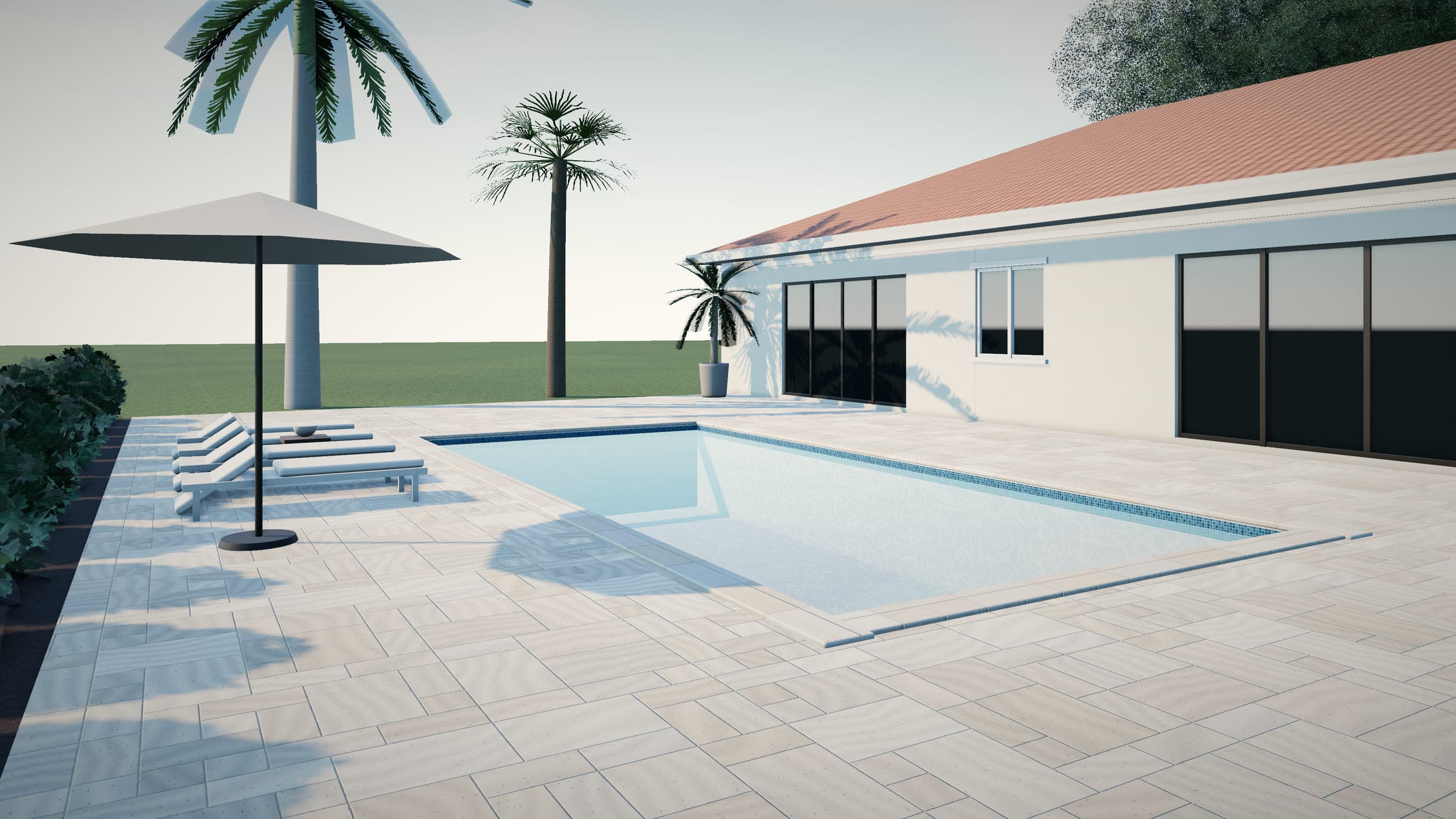
Pool decks should shed water away from the pool and the house toward deck drains or lawn, so dirty runoff doesn't wash into the pool. Existing deck drains are checked for condition and capacity. Any work near the coping is coordinated with a pool professional, and pool safety barriers must stay compliant throughout.
Questions to settle before installation
- Where does water go now during a heavy storm?
- Where will each downspout discharge after the project?
- What slope and outlet does the design use?
- What's the soil like, and what base material and depth are planned?
- Will the existing slab be removed or overlaid — and why?
- Are there swales, easements, or HOA drainage rules to respect?
- Is there enough height at doors, coping, and walls?
- Would a permeable system make sense, and is the site suitable?
Bring your answers — or your storm photos — to a consultation, and these questions become part of the plan.